A vertically integrated stainless-steel manufacturer controls multiple production stages within one manufacturing system rather than depending entirely on separate processors for melting, rolling, finishing and inspection. Maruti Inox follows this integrated approach at its manufacturing facility in Mehsana, Gujarat, connecting primary steelmaking with downstream stainless-steel processing.
For industrial buyers, this structure matters because sourcing stainless steel is not simply a question of selecting a grade. Chemical composition, heat treatment, dimensional control, surface condition and inspection all influence whether the supplied material is suitable for subsequent machining, fabrication or component production.
What Vertical Integration Means in Stainless Steel Manufacturing
In practical manufacturing terms, vertical integration creates continuity between upstream steel production and downstream finishing.
At Maruti Inox, the documented production path progresses through melting, refining and billet or ingot casting before rolling and subsequent operations such as heat treatment, pickling or cleaning, cold drawing, peeling and grinding. Straightening and inspection are completed before material moves to packaging and dispatch.
This makes the company a vertically integrated steel manufacturer rather than solely a processor of externally produced stainless-steel bars.
Its manufacturing infrastructure integrates melting, rolling and finishing operations. The current brochure specifies 36,000 MTPA melting capacity, 60,000 MTPA rolling capacity and 30,000 MTPA bright bar processing capacity.
Stainless Steel Products Manufactured by Maruti Inox
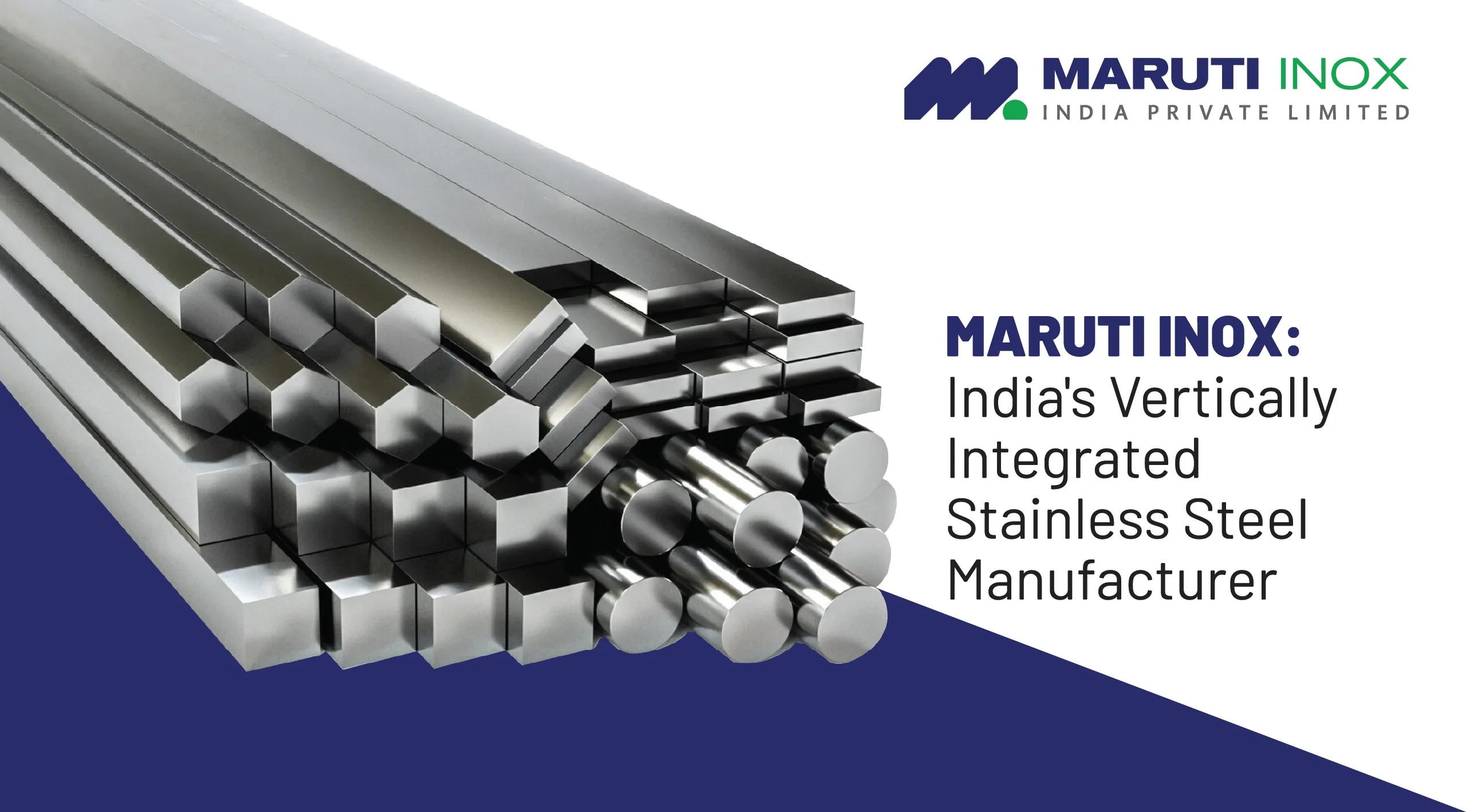
The product portfolio covers material at different stages of the stainless-steel value chain. It includes CC billets and ingots for downstream processing, RCS Bars, hot-rolled round bars, square and hexagonal bars, cold drawn/ground bright bars, peeled/ground bright bars, forged round bars, angles and flat bars.
The distinction between these forms is technically important. A buyer requiring material for further conversion may have different dimensional and surface requirements from an OEM purchasing precision-finished bright bars.
For example, cold drawn/ground bright bars are produced in round, square and hexagonal geometries, with documented H9/H11 tolerance for specified round sizes and H11 for square and hexagonal forms. Peeled/ground round bright bars are available with specified tolerance options including H9, H10, H11, K12, K13 and DIN 1013.
Quality Control Within the Manufacturing Route
For a trusted stainless-steel manufacturer, quality control needs to extend beyond final dimensional inspection.
Maruti Inox documents testing for chemical composition, mechanical properties and corrosion, along with surface roughness and magnetism testing. This allows relevant material characteristics to be evaluated before dispatch.
Maruti Inox’s quality management system is TÜV SÜD ISO 9001:2015 certified. For procurement teams evaluating suppliers, this certification provides documented assurance of consistent manufacturing controls across the production process.
Manufacturing from Gujarat for Domestic and Export Requirements
The manufacturing facility is located at Indrad in Mehsana district, Gujarat. From this location, the stainless-steel manufacturer Gujarat India supplies material within India as well as international markets.
The current company brochure states that its stainless-steel products are supplied across India and to more than 60 countries. Export preparation also extends to packaging: documented options include HDPE-wrapped bundles, ISPM-15 compliant wooden boxes, protective collars and rust-preventive wrapping.
These capabilities are particularly relevant when evaluating a stainless steel manufacturer and supplier in India for material that must retain its surface condition through handling and international transit.
Explore Maruti Inox’s stainless-steel product range and discuss your grade, size, tolerance and supply requirements with its technical team.
Frequently Asked Questions
Maruti Inox's current official website states that its stainless-steel manufacturing journey began in 2006, initially with scrap trading and steel melting before progressing towards an integrated production model.
It means multiple stages of the manufacturing chain are controlled within an integrated operation. At Maruti Inox, these include melting, casting, rolling, heat treatment, finishing, inspection and packaging.
Yes, the company's official identifies its quality management system as TÜV SÜD ISO 9001:2015 certified.
Its manufacturing facility is located in Indrad, Mehsana district, Gujarat, India.
Its documented range includes billets, ingots, Rolled RCS, hot rolled bars, bright bars, forged round bars, angles, and flats.
Yes, Maruti Inox supplies its stainless steel products across India and to more than 60 countries worldwide.