
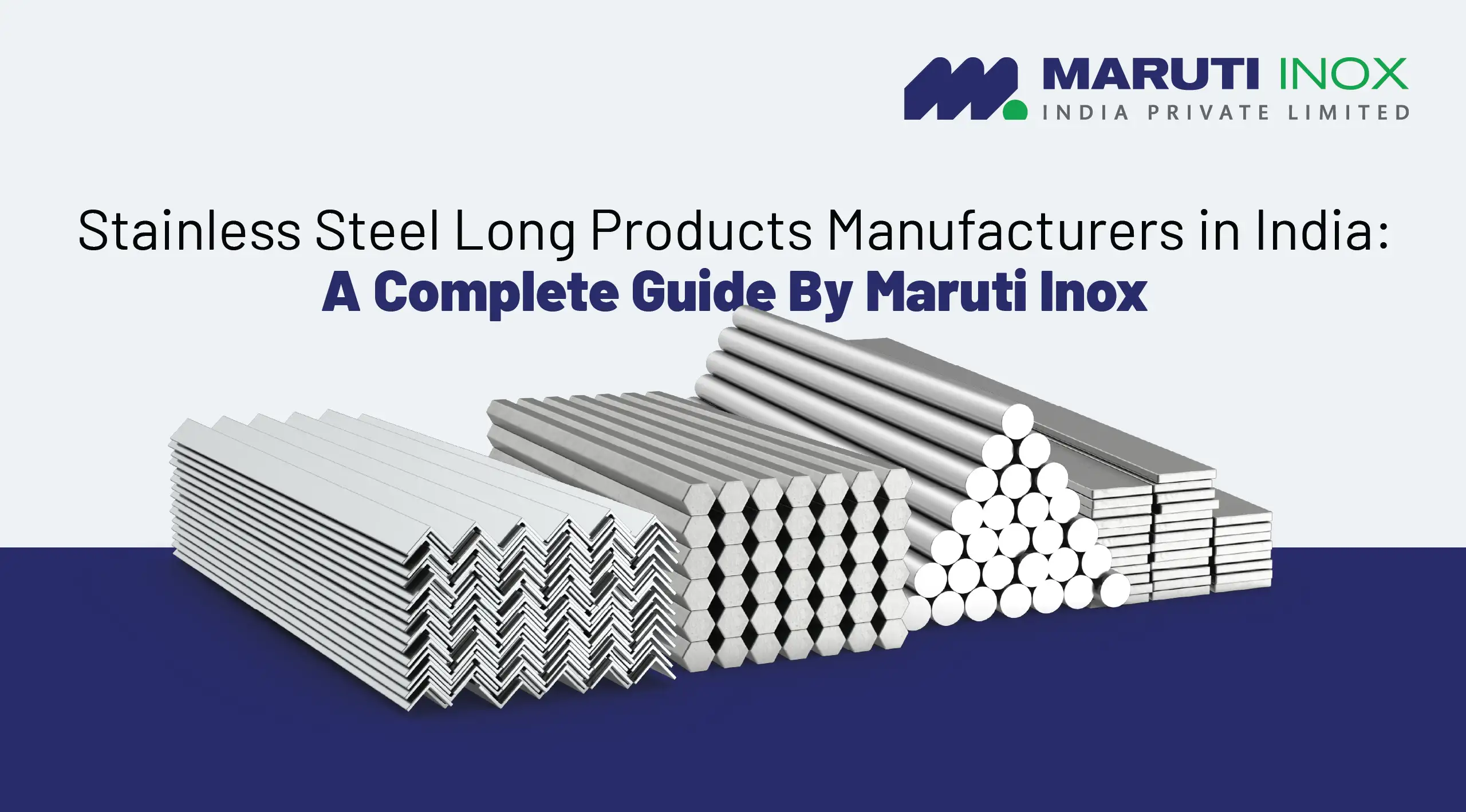
Stainless steel long products are semi-finished and finished metal forms used in machining, forging, fabrication, structural applications and industrial component manufacturing. They include continuous cast billets, forging quality ingots, hot rolled bars, bright bars, Round Corner Square (RCS) bars, forged round bars, stainless steel angles and flat bars.
When comparing stainless steel long products manufacturers in India, industrial buyers need to evaluate more than product availability. Manufacturing capabilities, grade consistency, dimensional tolerances, surface condition, inspection practices and material documentation all influence whether a product is suitable for its intended application.
Maruti Inox India Pvt Ltd is a stainless steel long products manufacturer based in Mehsana, Gujarat. Its integrated manufacturing operations connect melting and refining with casting, rolling and downstream finishing, enabling the production of different stainless steel long-product forms for industrial requirements.
What Are Stainless Steel Long Products?
Stainless steel long products are metal products manufactured in elongated or defined cross-sectional forms. Depending on their stage in the production process, they may be supplied as semi-finished material for further conversion or as finished bars and sections for machining, fabrication and engineering applications.
Unlike flat products such as sheets and plates, long products are commonly supplied in round, square, hexagonal, rectangular or other defined cross-sectional geometries.
Common examples include:
- Continuous cast billets: Semi-finished material used for further rolling and conversion.
- Forging quality ingots: Cast forms intended for downstream forging and hot-working operations.
- Hot rolled bars: Round, square and hexagonal bars produced through hot rolling.
- Bright bars: Precision-finished bars processed through methods such as cold drawing, peeling or grinding.
- RCS bars: Round Corner Square bars used as an intermediate product for further processing.
- Forged round bars: Bars produced through forging for applications requiring a suitable forged material form.
-
Stainless steel angles and flat bars: Sections used in fabrication, structural assemblies and industrial applications.
The appropriate product depends on the component design, required dimensions, material grade, finishing requirements and subsequent manufacturing process.
How Are Stainless Steel Long Products Manufactured?
Manufacturing route and process control are important considerations when evaluating stainless steel long products manufacturers. Each production stage influences the characteristics of the material supplied to the next stage.
1. Melting and refining
Stainless steel raw materials are melted and refined to achieve the required chemical composition. Grade requirements determine the alloying elements needed in the finished steel.
2. Casting into billets or ingots
The molten steel is cast into suitable forms for subsequent processing. Continuous cast billets and forging quality ingots serve different downstream manufacturing requirements and should be selected accordingly.
3. Hot rolling and forming
Billets or other suitable feedstock are processed through rolling to produce defined cross-sectional forms. The rolling route, dimensions and supply condition depend on the intended product.
4. Heat treatment and straightening
Where required by the product specification, heat treatment is used to achieve the specified material condition. Straightening helps bring the product within the applicable straightness requirements.
5. Downstream finishing
Additional processing may include cold drawing, peeling, grinding, pickling or other specified surface treatments. These operations are not interchangeable: each serves particular dimensional, surface or processing requirements.
6. Inspection and dispatch
The finished material is checked against the applicable requirements before packaging and dispatch. Inspection may cover chemical composition, mechanical properties, dimensions, surface condition and other specified characteristics.
At Maruti Inox, these operations form part of an integrated manufacturing route, with subsequent processes selected according to the product and its requirements.
Major Types of Stainless Steel Long Products Manufactured by Maruti Inox
1. Continuous Cast Billets
Continuous cast billets are semi-finished stainless steel products supplied to rolling mills and other downstream processors for further conversion.
Maruti Inox supplies continuous cast billets in square sections from 100 × 100 mm to 200 × 200 mm, with lengths up to 8 metres. Available supply conditions include as-cast and spot-ground.
Buyers should confirm the required grade, cross-section, length, surface condition and material documentation before placing an order.
Explore the available specifications of Continuous Cast Billets
2. Forging Quality Ingots
Forging quality ingots are cast steel forms intended for downstream forging and hot-working operations. Their suitability depends on the required grade, ingot dimensions, forging process and finished component requirements.
Maruti Inox supplies forging quality ingots in as-cast or spot-ground condition. The required material specification should be established according to the intended forging application.
Learn more about Forging Quality Ingots
3. Hot Rolled Stainless Steel Bars
Hot rolled bars are produced by rolling suitable steel feedstock into defined cross-sectional shapes. They may be used for further machining, forging, fabrication or other industrial processing.
Maruti Inox’s documented product ranges include:
- Round bars: 16–180 mm
- Square bars: 16–53 mm
- Hexagonal bars: 16–53 mm
Products are available in specified supply conditions, including as-rolled and straightened. Applicable dimensional requirements should be confirmed against the product specification and purchase order.
View the product details for Hot Rolled Round Bars
4. Stainless Steel Bright Bars
Bright bars undergo additional finishing to improve dimensional control and surface characteristics compared with the corresponding as-rolled condition. Depending on the product, finishing may involve cold drawing, peeling or grinding.
Maruti Inox manufactures bright bars in different shapes and size ranges:
- Cold drawn or ground round bars: 5–19 mm, with documented h9/h11 tolerances.
- Cold drawn or ground square and hexagonal bars: 16–50 mm, with documented h11 tolerance.
-
Peeled or ground round bright bars: 15–125 mm, with specified tolerances including h9, h10, h11, K12, K13 and DIN 1013 requirements.
The applicable tolerance depends on the product, process and specification. Buyers should confirm the required dimensions, tolerance class and surface finish rather than assuming every bright bar has the same characteristics.
Explore: Cold Drawn / Ground Bright Bars
5. Round Corner Square (RCS) Bars
Round Corner Square bars combine a square cross-section with rounded corners. They can serve as intermediate material for subsequent manufacturing operations, depending on the required component and process.
Maruti Inox documents RCS bars in sizes from 40–100 mm, in as-rolled, spot-ground and straightened conditions.
Discover the specifications of RCS Bars
6. Forged Round Bars
Forged round bars are produced through a forging process and supplied for further manufacturing where the required material form and specification call for forged stock.
Selection should account for the steel grade, bar dimensions, supply condition, machining allowance and requirements of the finished component.
Learn more about Forged Round Bars
7. Stainless Steel Angles and Flat Bars
Stainless steel angles and flat bars are used in industrial fabrication, structural assemblies and other applications where the required section geometry suits the component design.
Maruti Inox supplies stainless steel angles in hot-rolled and HRAP (Hot Rolled, Annealed and Pickled) conditions. Its documented angle range includes 20 × 20 mm to 50 × 50 mm, with lengths up to 6 metres.
Flat bar selection should similarly consider the required dimensions, grade, surface condition and fabrication requirements.
View the product details for Stainless Steel Angles and Stainless Steel Flat Bars
How to Evaluate Stainless Steel Long Products Manufacturers
Before selecting a stainless steel manufacturer or supplier, procurement and engineering teams should verify the following factors.
1. Product range and manufacturing capabilities
Confirm that the manufacturer supplies the required product form, size and processing condition. A company offering billets and ingots may serve different needs from one specializing in precision-finished bars.
Also determine which operations are performed in-house and which, if any, are outsourced.
2. Grade and chemical composition
Specify the required stainless steel grade and applicable material standard. Grades such as 303, 304/304L, 316/316L, 321, 410, 420 and 430F have different characteristics and are not interchangeable for every application.
The grade should be selected according to the required corrosion resistance, machinability, mechanical properties, operating environment and manufacturing process.
3. Dimensions and tolerances
Confirm the cross-sectional dimensions, length, dimensional tolerance and straightness requirements. For precision machining, the permitted dimensional variation can affect material preparation, machining allowance and component consistency.
Always check the applicable product specification instead of relying solely on a general catalogue range.
4. Surface condition and finishing
Clarify whether the application requires an as-rolled, as-cast, spot-ground, cold-drawn, peeled or ground condition. The appropriate finish depends on the required surface characteristics and subsequent operations.
A brighter surface does not, by itself, establish a particular mechanical property or corrosion performance.
5. Testing and inspection
Ask which inspections are available and which tests are required for the specific order. Depending on the specification, these may include chemical analysis, mechanical testing, corrosion testing, dimensional inspection and surface evaluation.
The actual testing scope should be agreed before purchase and supported by relevant documentation.
6. Material test certificates and traceability
Confirm the availability and scope of material test certificates (MTCs), heat or batch identification, and applicable inspection records. Documentation should correspond to the supplied material and the requirements of the purchase order.
7. Production capacity and delivery requirements
Evaluate whether the supplier can meet the required quantity, production schedule, packaging conditions and delivery commitments. For recurring orders, clarify specification consistency, order planning and communication procedures.
A useful supplier evaluation compares technical suitability, documentation, quality controls, delivery capability and total procurement cost-not price alone.
Stainless Steel Grades and Quality Requirements
Stainless steel is available in different types and grades, each offering a distinct combination of properties and suitable applications. The right material depends on the product requirements, manufacturing process and intended operating conditions.
The correct choice depends on factors such as:
- Exposure to moisture, chemicals or corrosive environments.
- Required strength, hardness and ductility.
- Machining, forging, forming or welding requirements.
- Operating temperature and service conditions.
-
Applicable standards and inspection requirements.
For a more detailed comparison, read our guide: Stainless Steel Grades Explained.
Why Consider Maruti Inox for Stainless Steel Long Products?
Maruti Inox is based in Mehsana, Gujarat, and operates an integrated stainless steel long-products manufacturing route. Its documented operations connect melting and refining with casting, rolling and downstream finishing.
The company’s current stated production capacity is 36,000 MTPA. Its product portfolio includes continuous cast billets, forging quality ingots, RCS bars, hot rolled bars, bright bars, forged round bars, stainless steel angles and flat bars.
Its documented inspection capabilities include chemical, mechanical, corrosion, surface-roughness and magnetism testing. The applicable inspection and documentation requirements should be confirmed for the specific product and order.
For industrial buyers, the relevant question is whether the manufacturer’s product range, production capabilities, specifications and inspection arrangements match the requirements of the intended application.
Explore the complete Maruti Inox product range or contact our team to discuss your requirements.
Frequently Asked Questions
Stainless steel long products are semi-finished and finished metal forms used in machining, forging, fabrication and industrial manufacturing. Common examples include billets, ingots, round bars, square bars, hex bars, bright bars and stainless steel angles.
Evaluate the manufacturer's product range, grade availability, dimensional tolerances, surface finish, testing capabilities, material test certificates and delivery capacity. Select a supplier that meets your technical and procurement requirements.
Hot rolled bars are shaped through hot rolling, while bright bars undergo additional finishing processes such as cold drawing, peeling or grinding to achieve specified dimensional tolerances and surface characteristics.
A material test certificate records relevant information about the supplied material, as required by the applicable specification and order. It can support verification of grade, chemical composition, mechanical properties and material identification where those details are included in the certificate.
Yes. Maruti Inox manufactures stainless steel long products at its facility in Mehsana, Gujarat. Its product portfolio includes continuous cast billets, forging quality ingots, hot rolled bars, bright bars, RCS bars, forged round bars, angles and flat bars.