
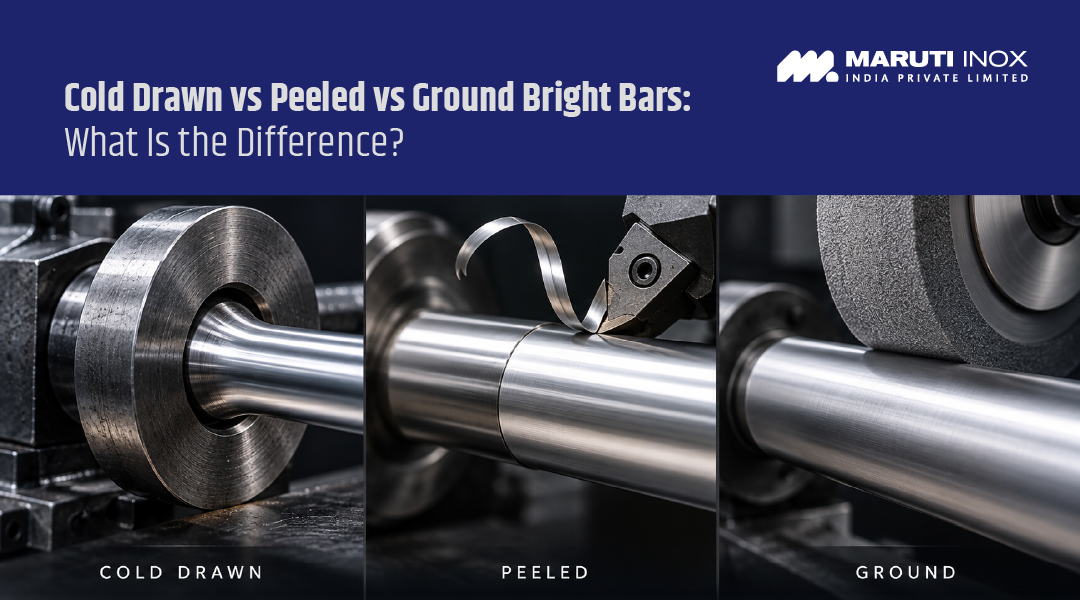
Cold drawing, peeling and grinding are different processing routes used to achieve specific dimensional and surface conditions in stainless steel bright bars. Understanding how these processes differ helps engineers and buyers specify material according to the next manufacturing operation rather than selecting a bright bar only by grade and diameter.
Maruti Inox produces cold-drawn/ground bright bars and peeled/ground bright bars within its documented stainless steel long-product range. Its manufacturing route also incorporates drawing, turning and grinding according to product requirements.
How Does Each Bright Bar Process Work?
Although cold drawing, peeling and grinding can all be associated with bright-bar production, they do not affect the bar in the same way.
Process | What happens | Main purpose |
Cold drawing | The bar is drawn through a die, reducing and controlling the section | Closer dimensional control and improved surface condition |
Peeling | Material is machined from the outer surface of round stock | Remove the outer surface layer and control the round section |
Grinding | A controlled amount of surface material is removed | Achieve the required surface condition and, where specified, closer dimensional control |
Cold Drawing
Cold-drawn bright bars are produced by drawing material through a die. The process reduces and controls the section while improving dimensional consistency and surface characteristics.
Maruti Inox manufactures cold-drawn round, square and hexagonal bright bars.
Peeling
Peeling uses a different approach. Instead of drawing the complete section through a die, material is removed from the outer surface of round bar stock.
Peeled bars can subsequently undergo grinding and polishing when the required finished condition calls for further control of the outside surface.
Grinding
Grinding is a finishing operation in which controlled surface material is removed to achieve the required surface condition and, where specified, closer dimensional control.
This is why cold drawing, peeling and grinding should not be treated as interchangeable processes. Drawing changes the section through deformation, while peeling and grinding remove material from the surface.
Cold Drawn vs Peeled Bars: What Is the Practical Difference?
The main difference between cold-drawn and peeled bars is how the required dimension and surface condition are achieved.
Cold drawing shapes the section through plastic deformation as the bar passes through a die.
Peeling machines away the outer layer of round stock, which can then be ground or polished when additional surface or dimensional control is required.
For buyers, the important point is that the processing route should be selected according to the required final condition, rather than treating cold-drawn and peeled bars as interchangeable products.
Maruti Inox’s manufactures cold-drawn range includes:
- Round sections: 5–19 mm
- Square sections: 16–50 mm
Hexagonal sections: 16–50 mm
Its documented cold-drawn tolerances include h9/h11 for rounds and h11 for square and hexagonal sections.
Peeled and Ground Bright Bars for Larger Round Sections
Maruti Inox manufactures peeled and ground bright bars specifically in round sections from 15–125 mm.
Available tolerances include h9, h10, h11, K12, K13 and DIN 1013, with the supply condition stated as peeled/ground and polished. Length varies according to diameter.
This creates an important specification distinction. The documented cold-drawn range covers round, square and hexagonal geometries, while the peeled/ground range is documented for round bars and extends to larger diameters.
Therefore, buyers should consider geometry, diameter, tolerance and required surface condition together when selecting between the available bright-bar routes.
Why Are Bright Bars Ground?
Grinding is used when the required surface and dimensional condition cannot be achieved through the preceding manufacturing route alone.
It removes a controlled amount of material from the surface to achieve the specified finish and, where required, closer dimensional control.
For buyers asking which bright bar is suitable for precision machining, there is no universal answer based only on the process name. Bar geometry, starting dimension, tolerance, surface requirement and machining allowance should determine the appropriate selection.
Maruti Inox specifically describes its peeled bars as having enhanced surface finish and dimensional accuracy for precision applications.
How Do I Choose the Right Bright Bar?
Start with the finished component and its machining requirements. Establish the material specification first, then select the processing route that can provide the required final condition.
Before selecting a bright bar, define:
- Grade – Identify the stainless steel grade required for the application.
- Geometry – Determine whether the component requires round, square or hexagonal stock.
- Starting size – Define the required diameter or section size.
- Tolerance – Specify the dimensional tolerance required by the component or machining process.
- Surface condition – Establish the required surface finish or condition.
- Machining allowance – Consider how much material will be removed during subsequent processing.
Length – Define the required bar length.
The processing route should then be selected according to these requirements.
Maruti Inox supports bright-bar processing with in-house testing capabilities, including surface-roughness testing alongside chemical, mechanical, corrosion and magnetism testing.
For your bright-bar requirements, share your grade, section, size, tolerance and required supply condition with Maruti Inox. Contact our team to discuss the appropriate manufacturing route.
Frequently Asked Questions
Cold drawing controls the section through deformation, peeling removes the outer layer of round stock, and grinding removes a controlled amount of surface material as a finishing operation.
Neither process is automatically better. Selection should be based on the component geometry, starting dimension, required tolerance, surface condition and machining requirements.
Peeled and ground bright bars provide round starting stock where controlled dimensions and improved surface condition are required for subsequent precision processing.
Start with the component drawing and define the required geometry, size, tolerance, surface condition and machining allowance. The appropriate processing route can then be selected based on these requirements.
Maruti Inox documents h9/h11 for cold-drawn rounds, h11 for cold-drawn square and hexagonal bars, and h9, h10, h11, K12, K13 and DIN 1013 for peeled/ground rounds.
First establish the required geometry and size. Then compare the required tolerance, surface condition and machining allowance with the characteristics of each available processing route.